Organizing children's toys: solutions and rotation
Stepping on Legos? Bins overflowing? Try toy rotation.
Recommended Materials
- Transparent storage bins
- Low shelves (accessible)
- Labels (with images)
Steps to follow
Step 1
The observation (Too many toys kills the play): When a child has 50 toys in front of him, he is overwhelmed, plays with nothing and ends up knocking everything over. The goal is to reduce the accessible quantity to encourage concentration and creativity.
Step 2
The rotation method (Montessori): Leave only a small selection of toys available (about 10-15) presented in an airy way on low shelves (accessible without help). Store EVERYTHING else in opaque boxes or closed cupboards, out of sight.
Step 3
The change cycle: Every 2 or 3 weeks, when you see the child getting bored, 'rotate' the toys. Put away those that are out and take new ones out of stock. The child will feel like they are receiving new gifts every time. This renews interest without spending a cent.
Step 4
Regular sorting: Take advantage of the rotation to sort. Discreetly throw away what is broken or incomplete. Put aside what is no longer age-appropriate to give or sell. The less clutter there is, the easier it is to tidy up.
Step 5
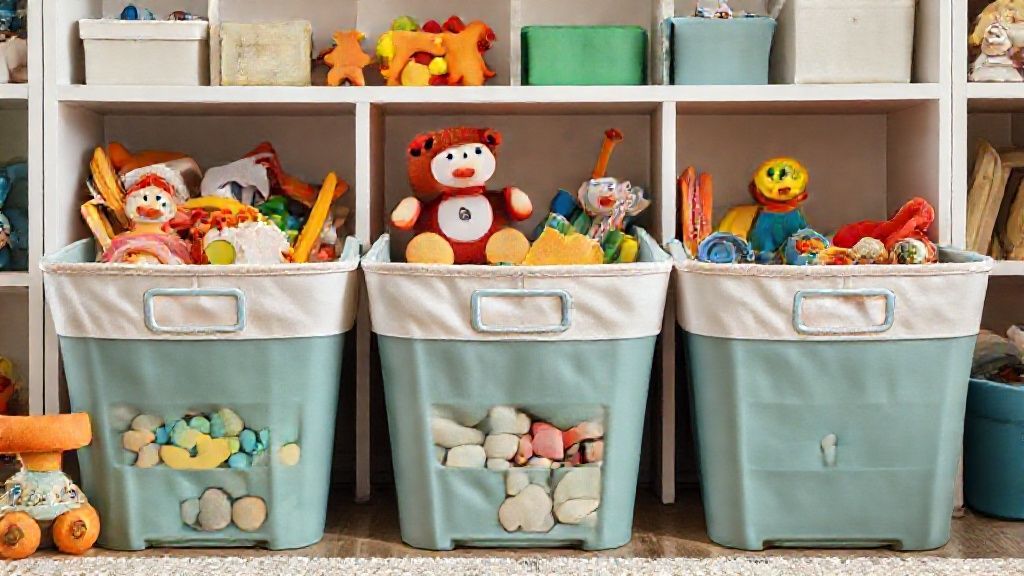
Visual storage system: For accessible toys, use open bins or baskets. For children who cannot read, stick a photo or drawing of the content on the bin (e.g. a photo of Lego on the Lego bin). Tidying up becomes a matching game.
Frequently Asked Questions
Legos and small parts ?
Use a 'play mat bag' (play on it, and when finished, pull the string and everything is packed). For older kids, small transparent drawers sorted by color.
He refuses to tidy up ?
It's normal. Make the task fun ('Let's race?', 'Who puts away the red cars?'). And above all, if there are fewer toys out, tidying up takes 2 minutes instead of 20.
Precautions
- Watch out for small objects for under 3s.
- Fix shelves to the wall (tipping risk).